a wing of the museum · 魂
The Duel of Souls
魂の決闘 — the deep culture behind Yu-Gi-Oh!
Yu-Gi-Oh! wears ancient Egypt like a costume — but under the costume is something genuinely old, and genuinely moving: the idea that a game can be a way to face fate and death. We're a card shop, not Egyptologists, so the fantasy is marked as fantasy and the sources are named. Follow the line from a board of the dead to a boy solving a puzzle.
賭けと運命
kake to unmei — Games Against Fate
Long before games were entertainment, people played them to touch what they could not control — luck, the gods, fate. The oldest board we can still hold, the Royal Game of Ur, was buried in a Mesopotamian royal grave around 2600 BCE. A Babylonian tablet from far later — 177 BCE — records its rules and notes that its squares were also read for fortune-telling. A race of counters, and a way to ask the future a question. Egypt kept boards for the same wager — like the hounds-and-jackals game below, almost four millennia old, its pegs racing a course no player could force.
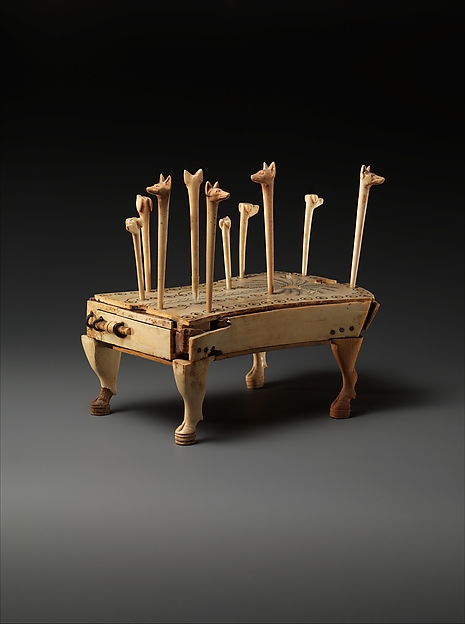
Purchase, Edward S. Harkness Gift, 1926 (26.7.1287a-k); Gift of Lord Carnarvon, 2012 (2012.508) — The Metropolitan Museum of Art · Public domain (Met Open Access) (source-declared; recheck the canonical record before reuse)
セネト
senet — The Board That Was a Passage
In Egypt they played senet (znt, "passing"), attested from the First Dynasty, around 3100 BCE. The living enjoyed it — but by the New Kingdom the same board had become a map of the soul's journey through the Duat, the underworld: each square a hazard on the way, the dead playing against an opponent no one could see. It appears in the Book of the Dead, and Queen Nefertari is painted at the board in her tomb. Its true rules are lost — what we "know" is careful modern reconstruction. Here is the oldest ancestor of a duel of souls: a game the living loved that doubled as a passage through death.
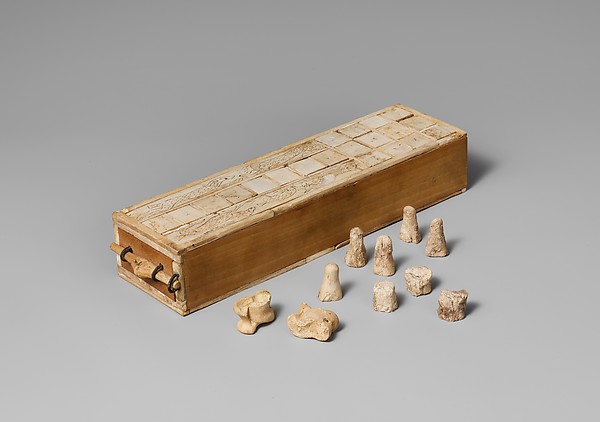
Rogers Fund, 1916 — The Metropolitan Museum of Art · Public domain (Met Open Access) (source-declared; recheck the canonical record before reuse)
闇のゲーム
yami no gēmu — The Shadow Game
Three thousand years later — in fiction — a boy named Yugi (遊戯, "play") solves an ancient Egyptian puzzle and wakes the spirit of a pharaoh. (The Japanese original says 3,000 years; the English dub inflated it to 5,000.) The Millennium Items (千年アイテム) and the Shadow Games — 闇のゲーム, literally "games of darkness," played for a soul — borrow real Egyptian furniture: the ka and ba (a person's life-force and soul), Ma'at's feather of truth, the weighing of the heart, the Duat. But say it plainly: this is a romanticized, fantasy Egypt, not Egyptology. The game does not teach the past — it uses it as an engine of meaning.
三幻神
Sangenshin — Three Phantom Gods
At the story's summit stand the Egyptian God Cards — 三幻神, the "three phantom gods." Here is a small, honest lesson in how myth gets made: of the three, only two carry the names of real deities — Osiris (the Japanese name of the card the West calls "Slifer") and Ra. The third, Obelisk, is a monument, not a god. And "Slifer" honours no pharaoh at all: it is the surname of Roger Slifer, a producer on the English dub. A reverent surface; playful, commercial machinery underneath.
高橋和希
Takahashi Kazuki — The King of Games
The hand behind it was Kazuki Takahashi (高橋和希, born 1961). Yu-Gi-Oh! — 遊☆戯☆王, "King of Games" — began in Weekly Shōnen Jumpin 1996 as a manga about games in general; the card game inside it, "Magic & Wizards," grew so beloved it took over the story. He died in 2022, found in the sea off Nago, Okinawa; the authorities confirmed drowning, and no crime. It was later reported — attributed to a U.S. Army major, Robert Bourgeau, in Stars and Stripes — that he drowned trying to help swimmers caught in a rip current. We pass that on as it was given: a report, honestly sourced, about a life that ended in the water.
二百五十億
nihyaku-gojū oku — Tens of Billions
And the object itself. Magic: The Gathering (1993) was the first modern trading card game; Konami launched Yu-Gi-Oh's Official Card Game in Japan in 1999, and the international game in 2002. It became the best-selling trading card game there has ever been — more than 25 billion cards certified sold by 2011 (the "35 billion" figure you'll see quoted is an estimate, not a certified count). A myth about ancient games became a physical thing, traded by the tens of billions. It is the reason a museum for TCG can exist at all.
魂
tamashii — The Duel of Souls
So the line runs from a board that mapped the soul's passage through death to a card game about duelling souls — and it was never really about winning. From senet to the Shadow Game, people have played to face what they cannot control: fate, the dead, the self. That is the oldest thing in the deck, older than any card — 魂, tamashii, the soul, made into a game so a feeling could be shared. The same wish that runs through every card we hang next door in the gallery.
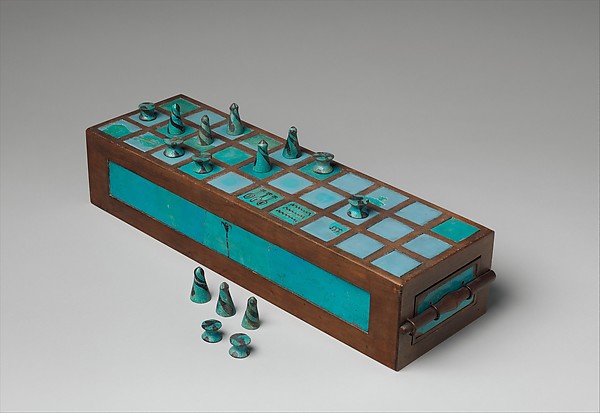
Gift of Egypt Exploration Fund, 1901 — The Metropolitan Museum of Art · Public domain (Met Open Access) (source-declared; recheck the canonical record before reuse)
Where we read this 出典
A card shop reaching for ancient Egypt and another culture's history should show its work — especially where a beloved game romanticizes the past. These are the sources behind the essay; museums and reporters did the real work. If we've got something wrong, tell us and we'll mend it.
- The Met — Board Games from Ancient Egypt and the Near East
- The British Museum — the Royal Game of Ur
- Wikipedia — Book of the Dead (weighing of the heart)
- Britannica — Maat (truth & cosmic order)
- Nippon.com — Yu-Gi-Oh! began as a manga about games
- Anime News Network — Kazuki Takahashi obituary & autopsy
- Stars and Stripes — the reported rip-current rescue
- Wikipedia — Roger Slifer (the God-card name)
- Guinness World Records — First modern trading card game
A companion piece traces the line of the drawing itself — the lineage of manga & anime 線の系譜. No licensed artwork is reproduced here — apart from the museum plates above (open-access, public domain, wall labels attached), the only pictures we hang are the cards themselves.
The oldest game was always played against fate.