a wing of the museum · 表現
The Lineage of the Line
線の系譜 — where the art comes from
The art on these cards descends from a very long line. We're a card shop, not scholars — so this is told plainly, the shaky claims marked as shaky, and the books we read named at the end. It is a lineage, not a family tree: currents that fed into one another over a thousand years, until a feeling learned to hold still on a page.
墨と間
sumi to ma — The Brush & the Space Between
Before the frame, the brush. In ink painting — 墨絵, sumi-e — a single stroke and the unpainted space around it (間, ma, the charged emptiness) leave the picture for the viewer to finish. From the Heian court came 物の哀れ, mono no aware: the gentle ache of things because they pass. Not a technique but a temperament — the sense that beauty and sorrow are one weather. Every quiet panel that lets you feel a pause is drinking from this well.
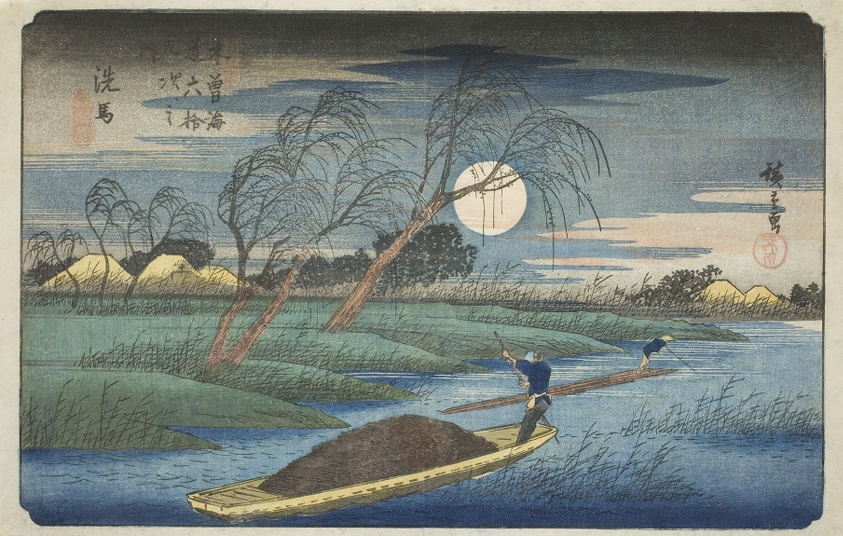
Gift of H. R. Warner — The Art Institute of Chicago · Public domain (source-declared; recheck the canonical record before reuse)
絵巻
emaki — The Story, Unrolled
By the 12th century, tales were painted on handscrolls — 絵巻, emaki — unrolled right to left, image following image, the way a manga page is still read. The Tale of Genji scroll is the oldest that survives. But these were continuous paintings, not divided into panels; the panel grid is a modern invention. So: lineage, not blueprint — yet the direction of reading, and the idea of a picture that moves through time, begins here.
鳥獣戯画
Chōjū-giga — Frolicking Animals
The Scrolls of Frolicking Animals — 鳥獣戯画 — painted in the 12th–13th centuries and kept at Kōzan-ji temple in Kyoto, show rabbits, frogs and monkeys behaving as people: caricature, motion, mischief, in nothing but line. It is often called the oldest manga. Scholars are wary of the label (some point to the Shigisan-engi scrolls instead) and of the traditional attribution to the monk Toba Sōjō — the brushwork looks like many hands. And it carries no words at all. Still: humour drawn in pure line, nearly a thousand years ago.
浮世絵と「漫画」
ukiyo-e to “manga” — The Floating World & the Word
In the Edo period the woodblock print gave everyone pictures of the floating world — 浮世絵, ukiyo-e — actors, lovers, Hokusai's great wave. Hokusai also filled sketchbooks he titled Hokusai Manga (北斎漫画, from 1814). He did not coin 漫画 — the word, meaning "whimsical, rambling pictures," was already in use — but he made it famous. And note it did not yet mean "comics." That sense came a century later.
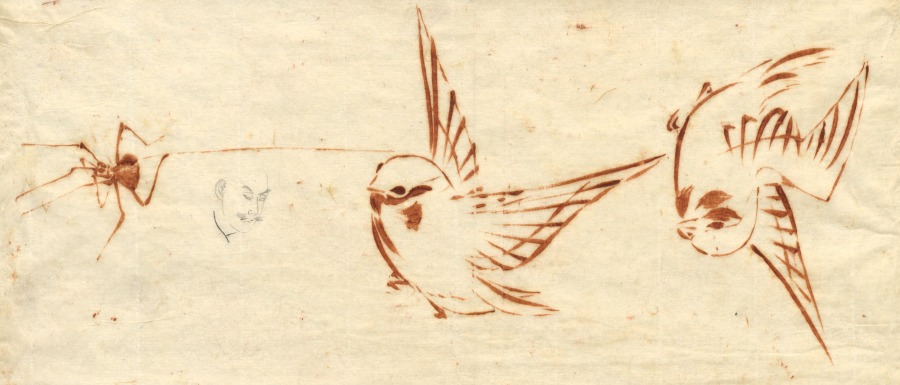
The Kelvin Smith Collection, given by Mrs. Kelvin Smith — The Cleveland Museum of Art · Public domain (CC0) (source-declared; recheck the canonical record before reuse)
紙芝居
kamishibai — Paper Theater
In the lean 1930s, storytellers rode bicycles into the streets with a little wooden stage and a stack of painted boards — 紙芝居, kamishibai, paper theater. A narrator would slide one card away, the next scene beneath it, and a crowd of children watched a story told frame by frame. When television arrived and emptied the streets, many of those artists carried their frames into rental comics and animation. A precursor, not a parent — but the frame was already at work.
漫画とアニメの誕生
manga to anime no tanjō — Cartoon, Camera, Atom
The modern form arrived when Western cartooning met the Japanese brush — a brush the picture-book had already trained: e-hon like the 1771 opening below had composed a drawn scene across a full printed spread for over a century. Around 1902, Kitazawa Rakuten fixed the modern sense of 漫画 — the serialized comic strip; in 1917 the first Japanese animators drew their first shorts. Then Tezuka Osamu (手塚治虫), "the god of manga," brought the camera onto the page — zooms, angles, motion — and on New Year's Day 1963 his Astro Boy (鉄腕アトム) became the first weekly TV anime a whole country sat down to watch. From brush to broadcast.
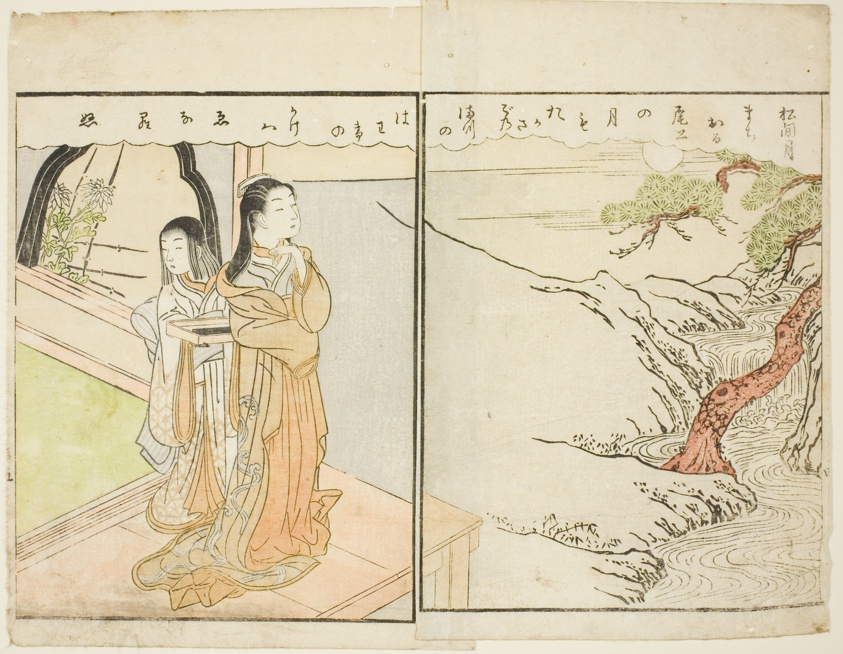
Gift of Chester W. Wright — The Art Institute of Chicago · Public domain (source-declared; recheck the canonical record before reuse)
表現
hyōgen — Expression
And the suffering you sensed? It is there — in specific hands. Nakazawa Keiji survived Hiroshima and drew it as Barefoot Gen (はだしのゲン). Takahata's Grave of the Fireflies (火垂るの墓) holds the war without looking away. Tezuka, who lived through it, filled robots and phoenixes with a plea for humanity. It would be too much to say a nation's pain explains a whole medium — but in these works, mono no aware becomes ink: beauty that aches because it passes. That is the oldest thing on any of these cards, older than the card itself — 表現, expression: the wish to make a feeling hold still long enough to be shared.
Where we read this 出典
A card shop reaching for another culture's history should show its work. These are the sources behind the essay above — museums, encyclopedias, and the people who study this properly. If we've got something wrong, tell us and we'll mend it.
- Stanford Encyclopedia of Philosophy — Japanese Aesthetics
- The Met — Japanese Illustrated Handscrolls (emaki)
- The Met — Woodblock Prints in the Ukiyo-e Style
- The British Museum — An introduction to Manga
- Japan Society — The Many Faces of Kamishibai
- Wikipedia — History of manga
- Wikipedia — Chōjū-jinbutsu-giga
- TezukaOsamu.net — Astro Boy production history
Further in print: Frederik L. Schodt, Manga! Manga! The World of Japanese Comics (1983); Adam L. Kern, Manga from the Floating World. No licensed artwork is reproduced here — apart from the museum plates above (open-access, public domain, each with its wall label and canonical record), the only pictures we hang are the cards themselves, in the gallery. A companion piece follows the line of the game instead — the deep culture behind Yu-Gi-Oh! 魂の決闘.
Every card is the far end of a very long brushstroke.